FAT12
Read, write, delete, mkdir, rmdir, rename, format — all in C, no assembly.
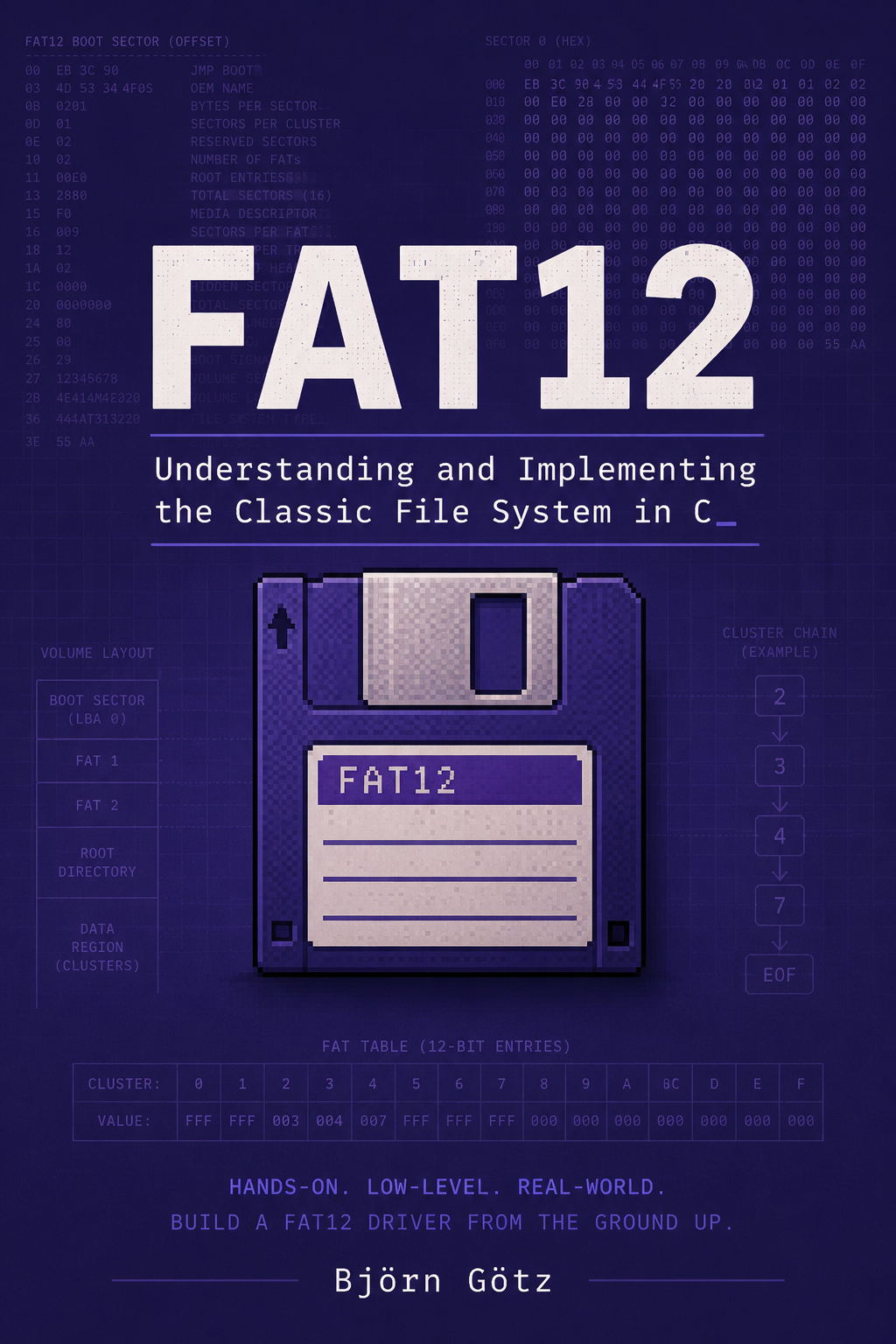
This book takes you from first sector to a complete, dual-platform FAT12 implementation. 11 chapters, ~1500 lines of C, one evolving codebase that compiles zero-warning on both your development machine and in QEMU as a 32-bit kernel.
FAT table walking, directory parsing — all of it
Read, write, delete, mkdir, rmdir, rename, format
Diagrams + step-by-step C for straddling entries
Same code runs in CLI tool and QEMU
GCC/Clang, no patching, no bit-rot
One evolving codebase from chapter 1 to 11
Leanpub sample includes chapters 1–3. No email required for the PDF.

Beta readers welcome
The manuscript is content-complete and I'm polishing it based on reviewer feedback. If you'd like a free copy in exchange for your thoughts, send me an email:
fat12@softwarefreak.netWhat makes this book different
Visual, byte-accurate diagrams
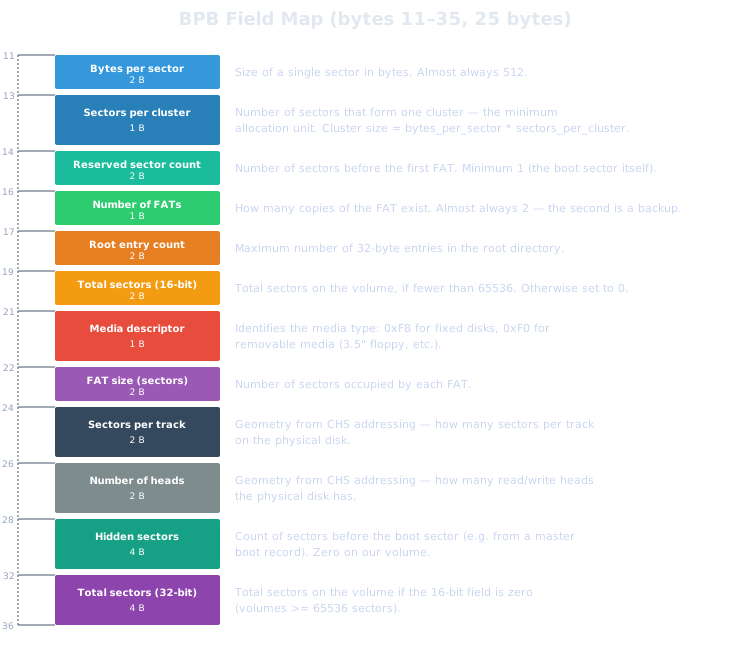
Every on-disk structure comes with a color-coded field map — no guesswork, no "offset 27 stores the first cluster, trust me." Here is the BPB layout, byte 11 through 35:
What's Inside
11 chapters, ~1500 lines of C, one evolving codebase:
See the code
Clean C, no magic. Here's the core typesystem your FAT12 driver starts with:
typedef struct
      {
          uint8_t  jmp[3];
          uint8_t  oem[8];
          uint16_t bytes_per_sector;
          uint8_t  sectors_per_cluster;
          uint16_t reserved_sectors;
          uint8_t  fat_count;
          uint16_t root_entry_count;
          uint16_t total_sectors_16;
          uint8_t  media_descriptor;
          uint16_t fat_size_16;
          uint16_t sectors_per_track;
          uint16_t head_count;
          uint32_t hidden_sectors;
          uint32_t total_sectors_32;
      } __attribute__((packed)) BPB;
Who is this for?
You — if you're building a hobby OS and need a filesystem driver. You know C (pointers, structs, bit manipulation) and want a complete FAT12 implementation you can drop into your kernel.
Recommended
OS Design Book Series by Ben Lunt — a comprehensive deep dive into operating system internals.